
.png)
Description
Download Poly by Google – free 3‑D assets, Creative Commons models, download tool
Overview of Poly by Google
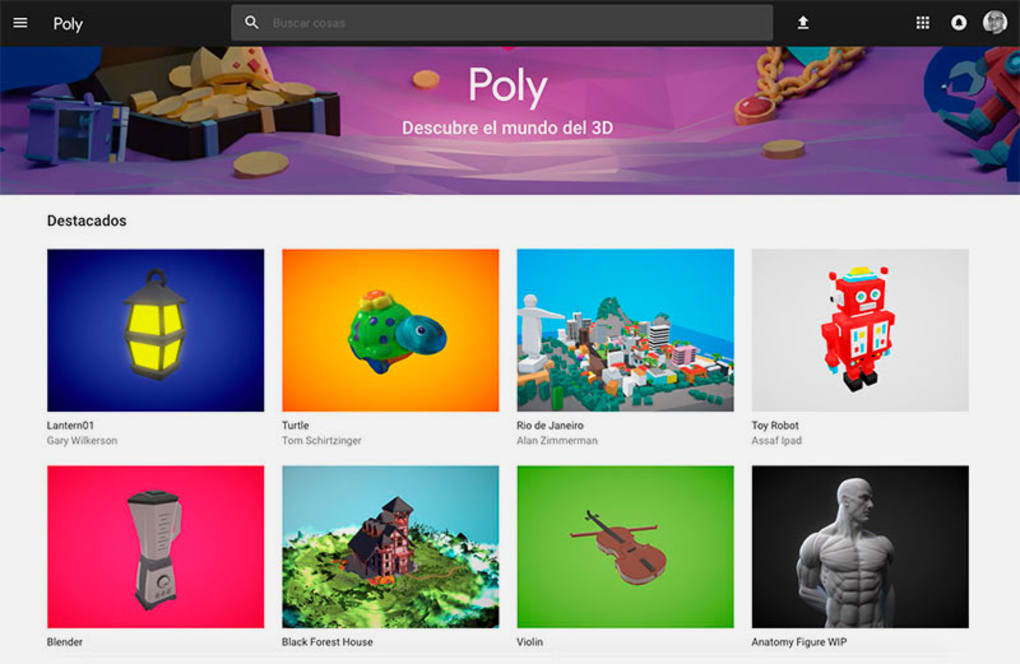
Poly by Google is a community‑driven library of three‑dimensional (3‑D) objects that anyone can browse, download, and reuse under Creative Commons licences. Launched as a free service, Poly provides designers, developers, game creators, and educators with a searchable catalog of thousands of models ranging from simple geometric shapes to complex characters and environmental assets. The platform’s core mission is to lower the barrier to entry for 3‑D content creation by offering an open, searchable database where creators can both contribute and benefit from a shared pool of resources. Because all assets are free to download, Poly has quickly become a go‑to source for rapid prototyping, AR/VR experiences, and game‑engine integration.
The user‑generated nature of the library means that the quality and style of models can vary, but Google’s curation tools—such as rating systems, tags, and preview renders—help surface the most useful and high‑quality assets. Users can also filter results by licence type, polygon count, and file format, making it easy to find exactly what fits a particular workflow. While the service was originally intended for Google’s own AR/VR initiatives, it has grown into an independent, cross‑platform resource that supports a wide array of creative projects.
Key Features and What Makes Poly Stand Out
- Extensive library of over 30,000 free 3‑D models.
- Creative Commons licensing ensures legal reuse and remixing.
- Advanced search filters: category, format (OBJ, FBX, glTF), polygon count, and licence.
- High‑resolution thumbnail previews and interactive 3‑D viewers.
- Direct integration with popular game engines like Unity and Unreal via downloadable packages.
- Community rating and comment system to highlight popular or well‑documented assets.
- Automatic metadata extraction (author, creation date, tags) for better discoverability.
- Regular updates and new submissions from a global creator community.
- Secure Google‑backed hosting with SSL encryption for safe downloads.
- API access for developers who want to embed search functionality into their own tools.
The combination of a massive, free library and Google’s robust infrastructure gives Poly a reliability edge over other file‑sharing sites like Pixabay or Sketchfab. Because all assets are hosted on Google Cloud, download speeds are consistently fast, and the platform benefits from the same security standards used across Google’s suite of products. Moreover, the inclusion of an API means that developers can programmatically query the database, pull model metadata, and even automate batch downloads—an especially powerful feature for studios that need to populate large environments quickly.
Another standout feature is the seamless workflow with Google’s ARCore and Sceneform tools. Users can import Poly assets directly into AR projects, reducing the time spent on format conversion. This tight integration reinforces Poly’s positioning as a cornerstone for rapid AR/VR prototyping, while still being flexible enough for traditional game development pipelines.
Installation, Usage Instructions, and Compatibility
Getting started with Poly is straightforward because there is no traditional “installation” required—Poly is a web‑based service. To download a model, simply navigate to the Poly website, use the search bar or browse categories, and click the “Download” button on the model’s detail page. You’ll be prompted to choose a file format (OBJ, FBX, or glTF) that matches your target application. Once selected, the model is packaged in a ZIP archive containing the geometry, textures, and a JSON manifest describing the asset’s metadata.
After downloading, extract the ZIP file to a folder of your choice. Most 3‑D software (Blender, Maya, 3ds Max) and game engines (Unity, Unreal Engine) can import these formats directly. For Unity users, simply drag the extracted folder into the “Assets” panel; Unity will automatically generate the appropriate material assets. Unreal Engine users can import the FBX file via the “Import” dialog and adjust import settings for collision and LODs as needed.
Compatibility (itemprop="operatingSystem"): Because Poly delivers standard 3‑D file formats, the assets are compatible with any operating system that supports the target software. This includes Windows 10/11, macOS 10.15 and later, Linux distributions with compatible 3‑D tools, as well as mobile platforms (Android, iOS) when used within AR frameworks like ARCore or ARKit. No additional plugins are required, making Poly a truly cross‑platform resource.
For developers who want to integrate Poly into custom pipelines, Google provides a RESTful API with OAuth 2.0 authentication. The API returns JSON payloads that list available models, filter by tags, and provide direct download URLs. Documentation is available on the Google Developers site, and example code snippets are provided for JavaScript, Python, and C#.
Security is handled automatically: all downloads are served over HTTPS, and Google’s anti‑malware scanning ensures that files are safe. Users should still verify that textures and meshes meet their project’s performance budget, especially when targeting mobile devices where polygon count and texture size are critical.
Pros and Cons, Frequently Asked Questions
Pros
- Completely free with no hidden fees.
- Large, ever‑growing library of diverse 3‑D models.
- Creative Commons licences simplify legal reuse.
- Fast, secure Google‑hosted downloads.
- Rich search filters and preview tools.
- Direct integration with Unity, Unreal, ARCore, and Sceneform.
- API access for automated workflows.
Cons
- Quality varies because assets are user‑generated.
- Some models lack detailed documentation or texture maps.
- Poly’s service was announced as “sunset” in early 2021, creating uncertainty about long‑term availability.
- No native desktop client; everything is web‑based.
- Limited advanced licensing options beyond Creative Commons.
FAQ (itemscope itemtype="https://schema.org/FAQPage")
Is Poly still actively maintained?
Google announced in early 2021 that Poly would be discontinued in 2022, but the archive remains publicly accessible. While no new features are being added, the existing library continues to be hosted and can be downloaded securely.
Can I use Poly assets in commercial projects?
Yes, as long as the asset’s Creative Commons licence permits commercial use (typically CC‑BY). Always check the specific licence badge on the model’s page and provide proper attribution when required.
What file formats are available for download?
Poly offers OBJ, FBX, and glTF (both .gltf and .glb) formats. The choice depends on the target application—glTF is preferred for web‑based and AR/VR experiences, while FBX works best with Unity and Unreal.
Do I need a Google account to download models?
No. Poly allows anonymous downloads. However, creating a free Google account lets you bookmark favorites, submit your own models, and leave comments or ratings.
How can I integrate Poly assets into Unity automatically?
Use the Unity Asset Store’s “Poly Importer” package (available as a community‑maintained plugin). It connects to the Poly API, lets you search within the Unity editor, and imports selected models directly into your project with correct material setup.
Conclusion & Call‑to‑Action
Poly by Google remains one of the most valuable free resources for creators who need quick access to high‑quality 3‑D assets. Its open‑licence model, extensive catalog, and seamless integration with major development tools make it an essential addition to any designer’s toolkit, even as the service approaches its end‑of‑life phase. If you’re looking for a secure, fast, and cost‑free way to populate your AR/VR prototype, game level, or educational visualization, downloading from Poly is still a smart choice.
Ready to boost your project with free 3‑D models? Visit Poly by Google now, browse the library, and start downloading assets that fit your creative vision. Remember to check each model’s licence and give proper attribution where required. Happy designing!
Guides & Tutorials for Poly by Google
How to install Poly by Google
- Click the Preview / Download button above.
- Once redirected, accept the terms and click Install.
- Wait for the Poly by Google download to finish on your device.
How to use Poly by Google
This software is primarily used for its core features described above. Open the app after installation to explore its capabilities.
User Reviews for Poly by Google 0
No reviews found